

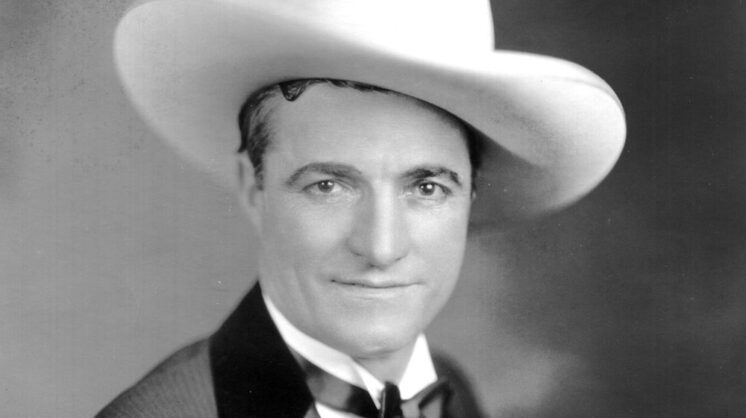
Some of the best-known Western film stars had connections to Oklahoma, including Will Rogers, Ben Johnson and Dale Robertson. But one of the first was Tom Mix, who was born in Pennsylvania and served in the Army for three years. He was discharged in 1901 and then re-enlisted. In 1902, while on furlough, he married Grace Allin. Marriage was more appealing than the Army and his agreement to return—he was listed AWOL but never court-martialed. In search of a new life, he and his wife moved to Guthrie in Oklahoma Territory.
Mix adapted quickly and had several jobs, including a bartender in the Blue Belle Saloon in Guthrie, a drummer in the Territorial Cavalry Band and night marshal in Dewey. He also was a ranch hand at the 101 Ranch and a performer in the Miller Brothers 101 Wild West Show.
He would marry five times and have two children. He had better luck with his movie career, beginning with his first feature film: Ranch Life in the Great Southwest. From 1909 to 1917, he made 236 movies for Selig Polyscope Co. Many were filmed in Oklahoma, New Mexico and Arizona, and at locations that included the Grand Canyon and the Royal Gorge.
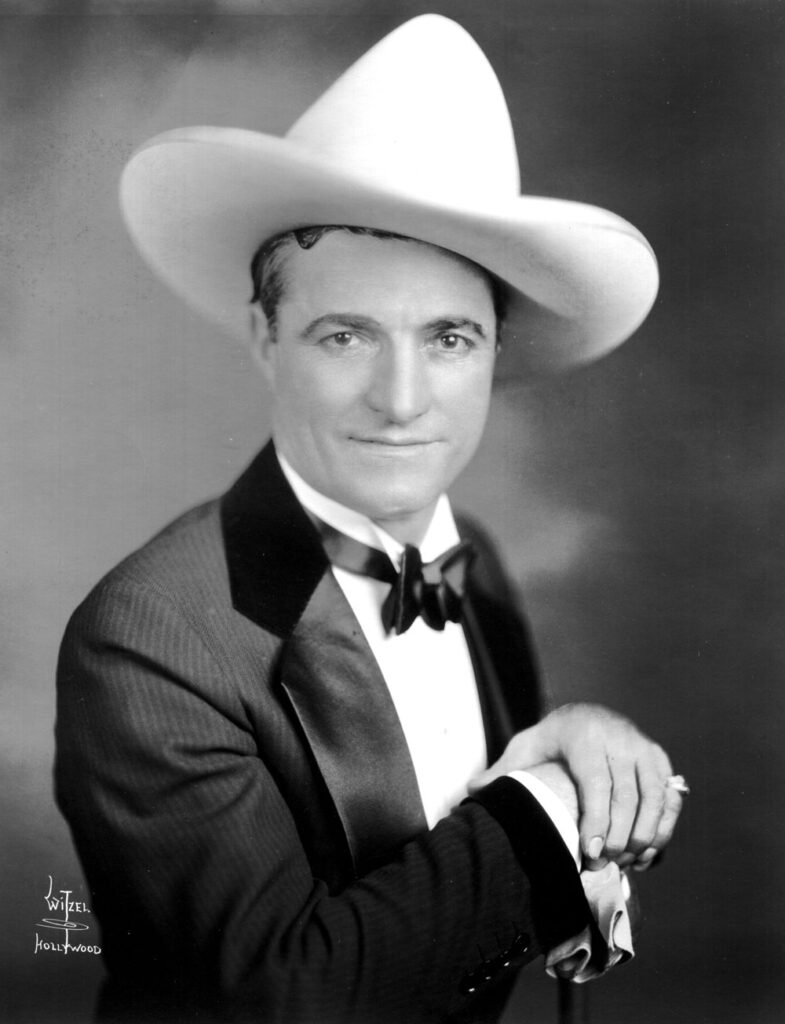
When Selig started having financial issues, Mix went to work for Fox Studios. Owner William Fox admired Mix, who did most of his own stunts with his horse Tony. He made 85 films with Fox and the budget increased with each one. So did Mix’s popularity.
He originally earned $350 a week, but fame boosted his salary eventually reaching $17,000 a week, making him Hollywood’s highest paid actor in 1928. His early films were about 15 minutes long, but moviegoers wanted more action and more Mix. Soon he was making multi-reel movies, usually wearing elaborate cowboy outfits and a 10-gallon Stetson hat.
He loved thrills and pushed boundaries if it enhanced a scene but protected his onscreen image. Only once did he lose a fight, and he never rode off into the sunset with the girl or played the guitar.
Mix lived a lavish life, with a custom-built mansion in Beverly Hills and a 1927 Rolls-Royce Phantom 1. He was an international star, but his career began to slide when talkies replaced silent movies.
In 1928, he left Fox and signed for half his usual salary with Joseph Kennedy’s FBO Pictures, and made five low-budget films. The last was completed in January 1929, the same month he was a pallbearer at his good friend Wyatt Earp’s funeral.
Mix, still wanting to work, turned his attention to rodeos and circuses. He enjoyed performing, the accolades and meeting people, but film lured him back. He signed with Universal Pictures for a year, a deal that made him the studio’s top Western star in talking pictures. He also lent his name to a radio series, “Tom Mix Ralston Straight Shooters,” with 15-minute shows broadcast worldwide three times a week.
Overall, Mix starred in 366 films from 1909 to 1935, producing 88, writing 71 and directing 117. His last film was The Miracle Rider, a 15-part serial released in 1935. It was one of only nine talkies that Mix made.
He died Oct. 12, 1940, when he lost control of his Cord Phaeton convertible and rolled into a dry wash area near Florence, Arizona. A heavy aluminum suitcase in the car hit the back of his head and broke his neck. He was 60 years old. The Tom Mix Museum in Dewey tells his story and showcases many of his personal possessions.