


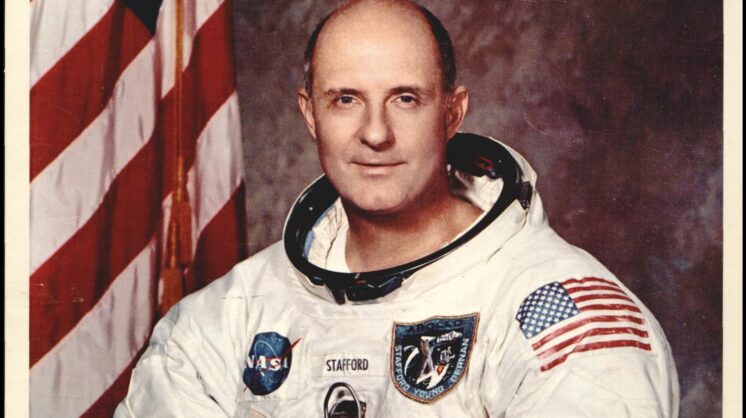
Thomas Stafford’s fascination with flying started at an early age as he watched planes soar over his home in Weatherford. It was the beginning of a lifelong passion for space exploration and flight, and a career that literally took him to new heights.
After graduating from Weatherford High School in 1948, he attended the United States Naval Academy, finishing in the top 1% of his class. He wanted to fly, so he transferred to the newly formed United States Air Force with its modern and more advanced aircraft. He earned his pilot wings, also known as “Silver Wings,” in 1953.
His dream was starting to come true. In 1959, he graduated first in his class from the Experimental Flight Test Pilot School at Edwards Air Force Base in California, became a test pilot instructor and co-authored two flight test manuals.
In 1962 he was one of nine selected for the second group of NASA astronauts for Projects Apollo and Gemini. Three years later he was the pilot on the two-man Gemini 6 for the world’s first rendezvous in space as they orbited a few feet from the Gemini 7 spacecraft.
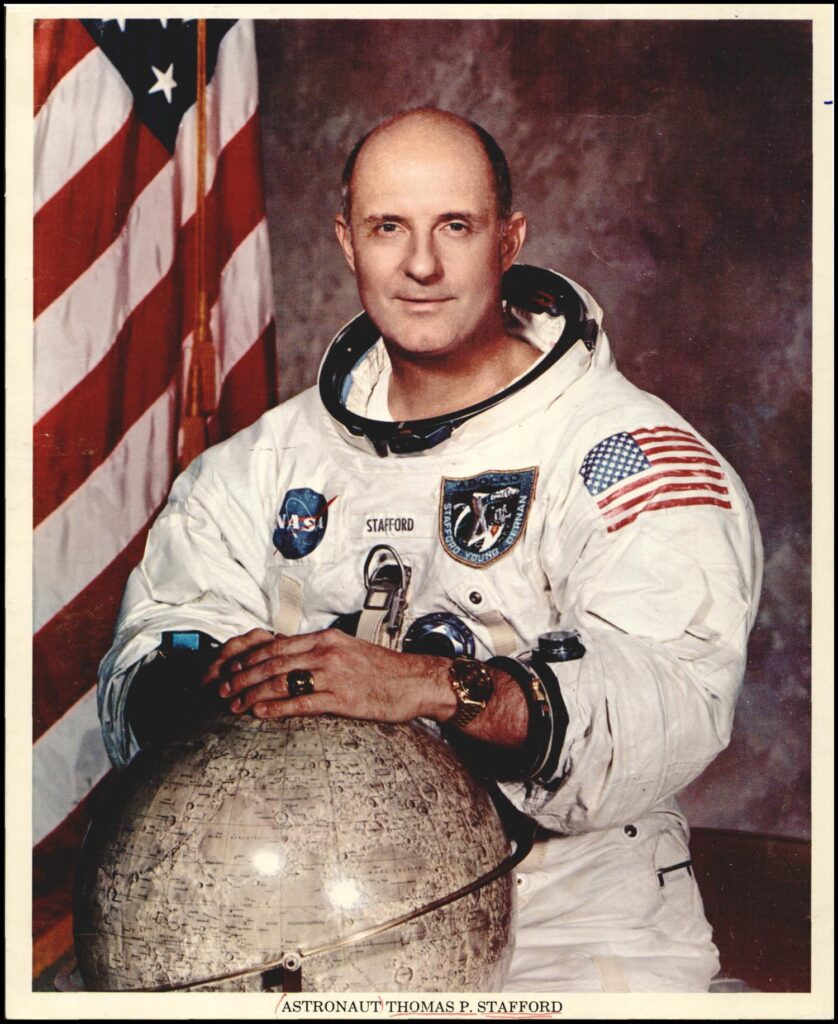
In May 1969, he commanded the Apollo 10 mission to the moon, and upon re-entry reached the highest speed ever achieved by man at 24,791 miles per hour or 7 miles per second. Apollo 10 was the dress rehearsal mission for the first moon landing.
He soon was named Chief of the Astronaut Office and later served as Deputy Director of Flight Crew Operations at Johnson Space Center. He oversaw astronaut training and mission planning, along with crew selections for the final moon landings and the Skylab Program.
He was promoted to Brigadier General and received his first star in 1972; the first astronaut to obtain that rank.
In 1975, he commanded the final Apollo mission, a rendezvous with a Soviet Soyuz capsule. The event was captured with photos of Stafford and cosmonaut Alexey Leonov shaking hands where the two crafts were joined. Stafford later said it was one of the greatest moments in his career. It was also his last trip to space.
Following that mission, Stafford resigned from NASA and returned to the Air Force, which assigned him to the post of commanding general of Edwards Air Force Base in California and its Experimental Flight Test Center. While there he earned his second and third stars and was commander of a top-secret test facility in the Nevada desert. It was also there that he learned of a new experimental technology called stealth.
Stafford never walked on the moon, but he flew six rendezvous in space and flew more than 127 different types of aircraft and helicopters, and four different types of spacecraft. He also rode on three different types of boosters into space.
His achievements could fill pages and pages in a history book. By the end of his career, he had spent nearly 508 hours in spaceflight, including two and a half days orbiting the moon. He retired in 1979, but it’s likely he still glanced up at the sky when he heard or saw a plane.
Stafford died March 18, 2024, at the age of 93. The Stafford Air & Space Museum in Weatherford offers an in-depth look at his life and career, along with a collection of artifacts.