

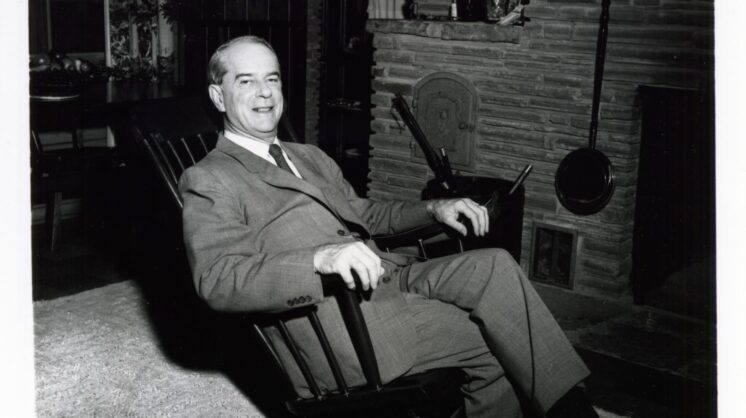
William P. “Bill” Atkinson may not have realized his goal to become an Oklahoma governor, but he achieved success in numerous endeavors, including the development of a planned city that would eventually become Midwest City.
Born in 1906 in Carthage, Texas, his life changed when his mother died and he, at 9 years old, went to live with relatives on their farm in Texas. A few years later he moved to town to live with an uncle and worked at a local newspaper while attending high school. Perhaps it was that work experience that influenced some of his later choices.
After graduating from Texas Christian University in 1928, he and his new wife moved to Oklahoma and started the Oklahoma City Star, a weekly newspaper. It was the beginning of a long and varied career that included the founding of the Tulsa Herald religious publication and helping build several chain papers throughout Tennessee, Texas and Kansas.
But Oklahoma City beckoned. He returned and taught journalism at Oklahoma City University and was head of that department from 1934 to 1938. He sold homes on weekends.
In the early 1940s, Atkinson learned the Army was looking for land near the middle of the country for a new military depot and later that the proposed U.S. Army Air Corps base would be in central Oklahoma.
He knew specific details about the land needed, though the exact location had not been officially announced. After studying maps and visiting with landowners, he concluded that the depot would be south of SE 29. He reached that conclusion after landowners south of the street were not willing to sell, but owners on the north side were eager.
He bought more than 300 acres for a housing development, with the original neighborhood streets given aviation names and the second section named after trees and shrubs with a coordinating tree or shrub in the yard.
Homes there were modest, but later Atkinson developed the Ridgecrest neighborhood with larger houses and lots and a backyard large enough for something special. He sweetened those sales with a free Shetland pony, and for those Ridgecrest homeowners who didn’t want a pony in their backyard Atkinson built a pony farm next to his home at Midwest Boulevard and NE 10.
Midwest City, established in 1942 and known for its forward-thinking design, was named “America’s Model City” in 1951 by the National Association of Home Builders. The city featured dedicated spaces for schools, businesses and parks with culs-de-sac and curving streets. Atkinson wanted Midwest City to be a place for families to live and raise children safely.
Atkinson was president of the National Association of Home Builders in 1951; he aspired to be the state’s leader, too, running unsuccessfully for governor in 1958 and 1962. But he wasn’t just a homebuilder. He founded the Oklahoma Journal newspaper in Midwest City and published it from 1963 to 1979.
He developed Quail Springs Office Park and was instrumental in creating what is now Rose State College. He also donated land for Midwest City Memorial Hospital.
In 1985 he received the University of Oklahoma’s Distinguished Service Citation, and in 1995, he was inducted into the Oklahoma Journalism Hall of Fame.
His historic 8,000-square-foot mansion in Midwest City is now the Atkinson Heritage Center with photos, family furnishings and memorabilia. Tours are also available. Atkinson died in 1999.