

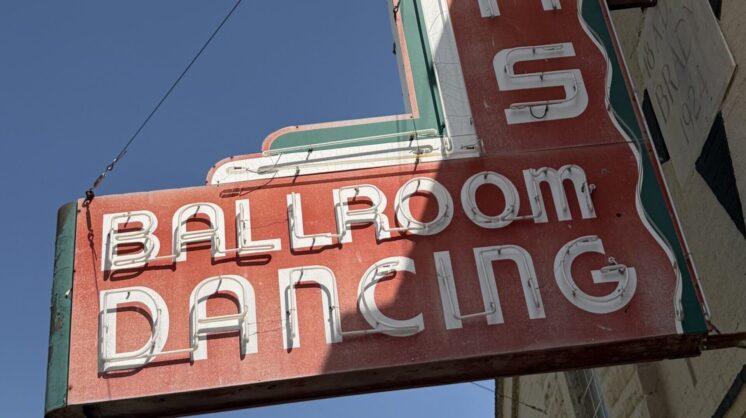
Cain’s Ballroom in Tulsa has welcomed countless performers over the past 90-plus years, many who were well-known at the time and others who were just starting to sing or play their way to success.
The now famous and nationally recognized music venue got its start as a personal garage for W. Tate Brady’s car collection. That was in 1924, but the Tulsa entrepreneur and politician soon changed his mind and turned the space into an elite night club called the Louvre. Its success was short-lived.
The next revival came in 1930 when Madison W. “Daddy” Cain purchased the building, renamed it Cain’s Dance Academy and enticed visitors with dime-a-dance events and opportunities to learn to waltz and do the Charleston.
Its popularity quickly spread outside of Tulsa as visitors came to dance on the much-heralded walnut floor that’s laid out in a square pattern and built to allow the wood to flex naturally. The floor had to be replaced once, but it was redone with the exact engineering to offer dancers the perfect bounce regulars had come to expect.
Early on, one of the best things to happen to Cain’s was the arrival of Bob Wills and the Texas Playboys. They used the venue as their base from 1935 to 1942. Their sound was new, a mix of country with everything from jazz to hillbilly to big band swing and boogie.
Cain’s became known as “The Home of Bob Wills.” It was where Wills and his Texas Playboys played and broadcast daily and nightly over KVOO, Tulsa’s powerful 50,000-watt radio station which could be heard across several states.
But the 1960s brought changes to the once popular venue. Attendance dwindled; poor management and business decisions added to the struggles; Wills’ health suffered, limiting his appearances—but more importantly, people were tuning into rock and roll.
Music-wise, Cain’s Ballroom was lost. In 1972, Marie Meyers bought the building and offered traditional dances. Her efforts were short-lived. Real hope came in 1976 when Cain’s was purchased and rescued by rock concert investor Larry Schaeffer.
The iconic venue reopened the next year with blues and rock musician Elvin Bishop, and later the Sex Pistols with Sid Vicious, who punched a hole through the wall after a performance on Jan. 11, 1978. That piece of wall is framed and on display inside the offices.
Cain’s has hosted Western performers as well as others who belted out swing, rock and punk. George Jones, Merle Haggard and Arlo Guthrie are just a few honored with red concrete stars embedded in the brick walkway outside the venue.
Other performers who have made appearances throughout the decades include Van Halen, The Flaming Lips, Robert Plant, Alison Krauss, George Jones, Willie Nelson and Chris Stapleton. Bob Dylan, Leon Russell, Hank Williams, Ernest Tubb, Tennessee Ernie Ford, The Police, Pat Benatar and Smashing Pumpkins were among countless others.
Cain’s history plays out inside with walls plastered with signs, show posters, photographs and signatures of musicians whose music filled the ballroom. The venue with standing room for 1,700 or 750 seated in rows is also known as the Carnegie Hall of Western Swing.
Cain’s is now owned by Chad and Hunter Rodgers, sons of Jim and Alice Rodgers, who purchased it in 2002.
Whether visitors come to dance or enjoy the music or just surround themselves with history, Cain’s continues to be one of the country’s most popular music venues. In 2020, the Los Angeles Times ranked Cain’s No. 4 on its list of Best Places for Live Music.