


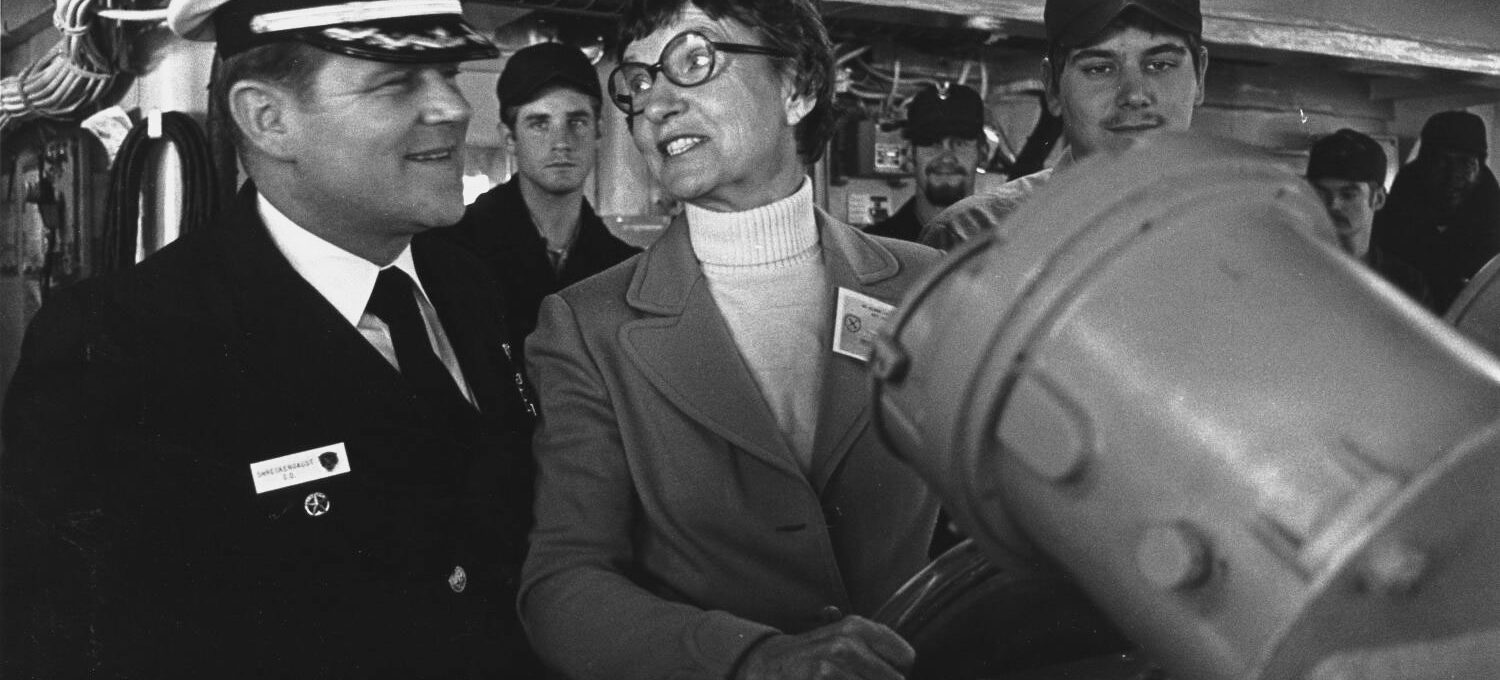
A future in politics may not have been on Patience Latting’s mind when she was a young girl, but a few decades later she would make history as Oklahoma City’s first female mayor.
She was born on Aug. 27, 1918, in Texhoma, a small town in the Oklahoma Panhandle. By the early 1930s, the family was living in Oklahoma City.
Latting graduated from Classen High School in 1934 and received a bachelor’s degree with honors in mathematics from the University of Oklahoma, where she graduated magna cum laude and was named outstanding senior woman. She followed those accomplishments with a master’s degree in economics and statistics from Columbia University in New York City.
She returned to Oklahoma, married lawyer and oilman Trimble B. Latting in 1941 and became active in both city and state issues and organizations. She was involved with the Parent Teacher Association and the League of Women Voters, and served as legislative chairman of the Oklahoma Congress of Parents and Teachers from 1960 to 1967.
She learned about statewide issues and concerns, including the under-representation of Oklahoma’s most populated counties, and was instrumental in drawing new state legislative district boundaries which would give equal representation to urban areas.
Her work resulted in court-ordered elections and the first realigned and fairly distributed Oklahoma Legislature convening in January 1965.
Latting’s career was just getting started. In 1967, she became the first woman elected to the Oklahoma City Council. She recognized the need for building codes and stricter housing, and encouraged Black participation in government.
As she became more involved, she also became aware and concerned about an abuse of power by some city officials. The answer was a run for political office and in 1971, she was elected Oklahoma City’s mayor. That accomplishment garnered national publicity as she was touted as the first woman to govern a major city with a population exceeding 350,000.
Latting was a Democrat, but she campaigned and won without party affiliation and was reelected in 1975 and 1979. Her three terms included a long list of accomplishments. Downtown Oklahoma City was redeveloped through urban renewal and a comprehensive zoning plan that ended underrepresentation of urban counties.
She was the city’s loudest cheerleader for improvement and growth. She supported the Pei Plan redevelopment initiative for Oklahoma City, in which dozens of low-rise structures were replaced with modern high-rise buildings. General Motors and Xerox opened operations in the state.
She secured long-term water supplies for the city and was an early supporter for new public spaces including Myriad Botanical Gardens and the Crystal Bridge. Downtown was redeveloped.
Perhaps just as noteworthy as her accomplishments, former Ward 2 Councilman C.R. Anthony once said she earned a reputation for “doing absolutely no political favors.”
Her mayoral terms and ideas weren’t always without opposition or setbacks. The Pei Plan fell short of its civic goals and the City Council objected to Urban Renewal projects in the 1970s. There was a police strike in the fall of 1975.
But good seemed to follow. Latting, who received several awards for her civic work, was inducted into the Oklahoma Hall of Fame in 1980. Another honor was the naming of the Patience Latting Northwest Library.
The National Municipal League presented her with the All-American City Award to Oklahoma City in 1978, and she was inducted into the Oklahoma Hall of Fame in 1980.
She retired in 1983 but continued her community service. She died on Dec. 29, 2012, after a lifetime of service to and for the city she called home.