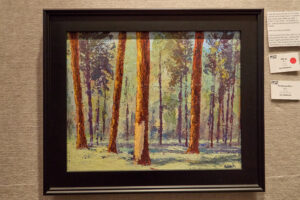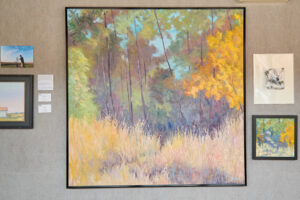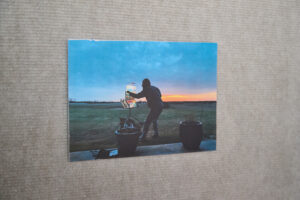


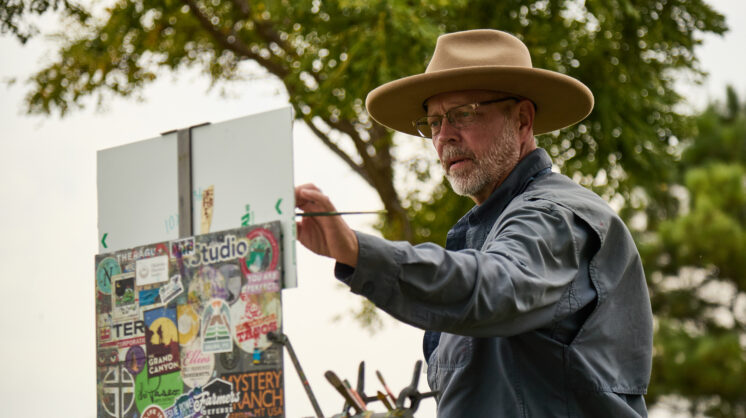
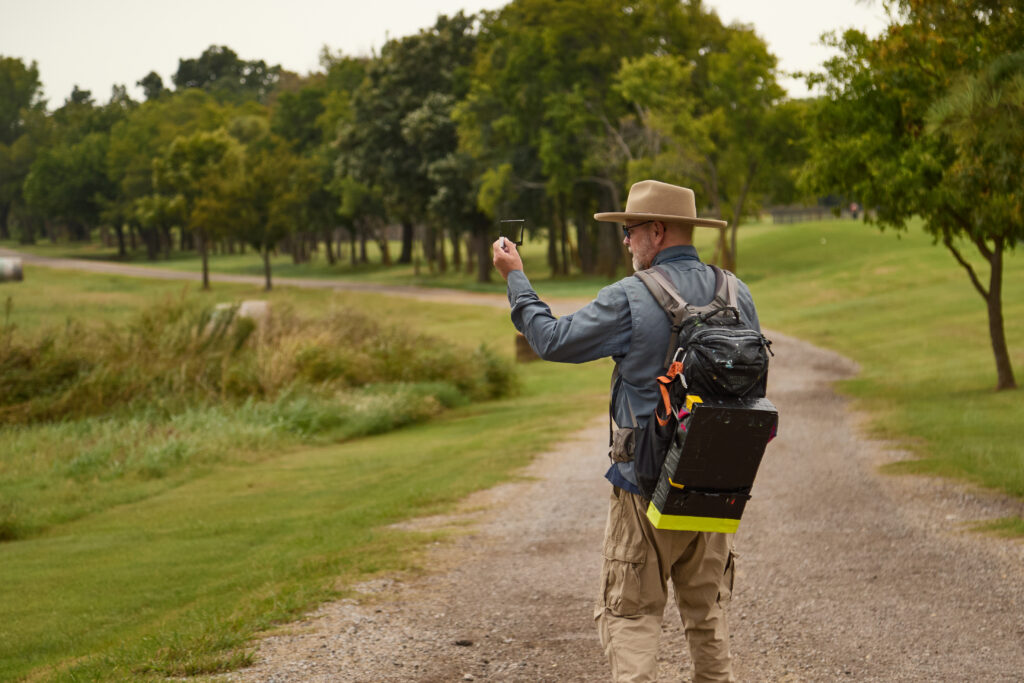
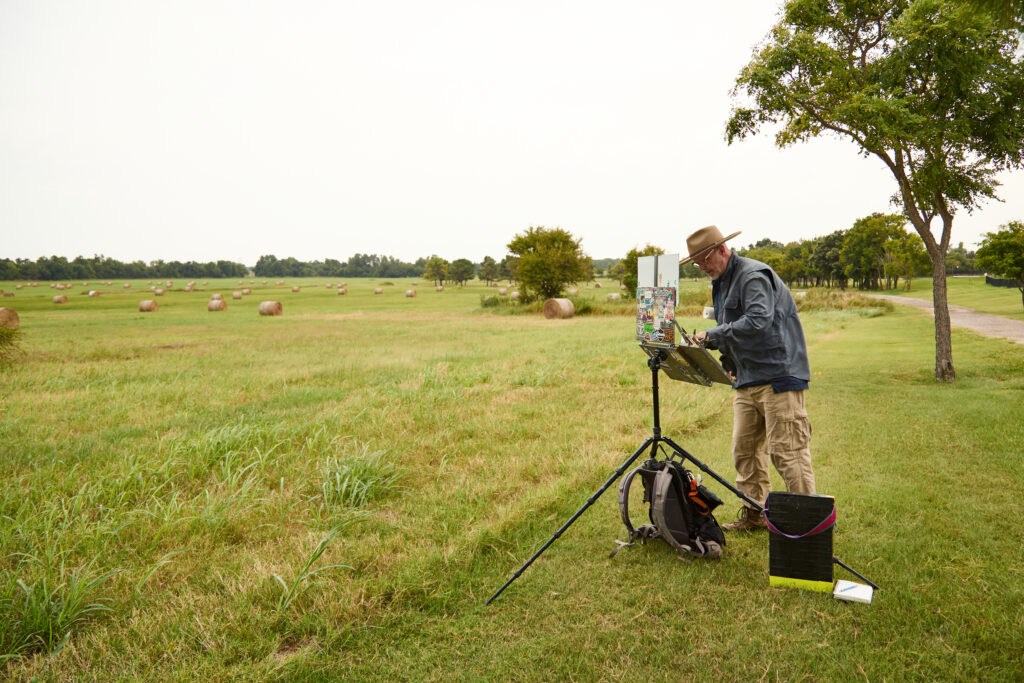
Somewhere in the middle of nowhere, contemporary impressionist artist Jay Holobach is capturing a scene. It may be snow-covered trees in Michigan or sunset-pink mountains in Colorado or hay bales on a flat Kansas horizon. Holobach drives along dilapidated roads nationwide, only stopping his “rolling art studio” when an area piques his interest. Then, he quickly paints before sunlight disappears. Once home, he often reworks the image, perfecting its composition and colors to produce what he calls a “living postcard” for others.
Holobach is driven by his passion for painting and connecting people to art. Locally, he teaches classes at Edmond Fine Arts (where he’s also a board member) and volunteers for Art with a Heart, an art therapy program benefiting children with cancer. We recently spoke with Holobach about his life and work.
Evie Klopp Holzer: How do you decide where and what to paint?
Jay Holobach: When I’m on location, if I see something I like, I’ll stop, drop and paint … I’m not the first person here, obviously, and these trees have been here for 50, 60, 100 years. Who else has walked by here? Did they see the same thing that I am now seeing—the filtering of the dappled light on the ground? I want to capture that to give to somebody who maybe has never been there before, so they can feel like they’re standing there. They can feel that vastness, that emptiness or the stillness; that’s what I’m trying to convey in my artwork. There’s always a story.
EKH: Why is the human-art connection important to you?
JH: To me, connecting people to art is very, very personal … Art heals. Think about a songwriter singing a song that cuts through all the layers and talks to you as an individual. I have found that if I can make my painting more specific to an individual, the broader the appeal; no different than a songwriter singing a song. You connect to it. You feel it. There’s a resonance there that’s really hard to describe, but you feel that personal connectivity. And there it is.
EKH: Tell me about your background in business.
JH: I’m a classically trained instructional designer, so I built corporate training programs. I worked at Raytheon, Northrop Grumman, NASA Johnson Space Center, General Motors, Philips medical … I would go in and work with subject matter experts to break apart their day jobs into pieces and to reconstruct that into a learning path.
EKH: How does this affect your approach to teaching painting?
JH: When you come to my class, you’re going to get a Participant Guide; you’re going to have a handout; you’re going to have a plan. I plan everything.

EKH: What would you say to a newcomer who says, “I can’t paint”?
JH: I think everyone can paint if they wanted to. It’s like golf. Everyone can play golf if they wanted but not everyone will hit the ball like Scottie Scheffler. That doesn’t stop folks from enjoying a pleasant day at the links. Painting is the same: Not everyone will paint like Monet, but that doesn’t mean they can’t enjoy pushing paint around a canvas. I think folks just need to give themselves permission to play.
EKH: You’ve traveled and lived in many places, yet you’ve made Oklahoma your home. Why?
JH: I can tell you one in one word: People. This is the nicest, easiest place I’ve ever lived.